Friday, January 2, 2015

Back to India

I recently was lucky enough to visit India for a friend's wedding and came back with a new appreciation of the cuisine. While mostly everything still had cumin in it, the amount was not offensive and I enjoyed nearly everything I ate. I'm going to spend a bit of time trying some recipes I picked up during the last few weeks. 

This week I decided to try my hand at paneer, naan, and palaak. Paneer was one of the easiest things I've ever made and was so tasty that I doubt I'll buy it in the package again. 

1/2 gal whole milk
Pinch of salt
1/4 c lemon juice
Cheesecloth

Bring the milk to a simmer and remove from heat. Add salt and lemon juice, stir very gently to not break up curds. Line a colander with cheesecloth and place into a large bowl. Pour curdled milk into colander. Set bowl of whey aside and rinse curds with water. Squeeze majority of water out with hands and then twist the cheesecloth and place it between two plated. Place a heavy weight on top and allow to drain for an hour or more. 

Naan:

Mix 1tsp active dry yeast in 1/4 c hot tap water and 1 Tbsp sugar. Allow to bubble for 10 minutes (longer if it is as cold as my house in the dead of winter). Add 1 c plain greek yoghurt, 3/4 c warm milk. 

In a large bowl, mix together 2 c each all purpose flour and whole wheat pastry flour, 1 1/2 tsp baking powder, 1 tsp baking soda, 1/4 tsp salt. Pour wet ingredients into the center of the dry ones and bring mostly together with a wooden spatula. Knead into a ball with hands but do not knead past this point! Allow to rise for an hour. Cut into about 8 equal portions and roll to an oval shape, 1/4 inch thick. Cook for 2-3 min each side in a lightly oiled cast iron skillet over medium heat. Garnish with olive oil, fresh herbs, garlic, etc. 

Palaak
In a food processor, bring together 1 medium yellow onion, 1-2 jalapeño peppers ( seeded), 2 inches peeled fresh ginger, 2 cloves garlic, 1 tsp ground coriander, 1 tsp turmeric, 1 tsp ground cinnamon, 1 tsp ground cardamom, 1/4 tsp allspice until smooth. Sautée over medium low heat for 10 minutes in 1 tbsp butter or ghee. Add 2 10-oz packages thawed spinach, 1 tsp salt, reserve whey from paneer to keep everything saucy. Cook for 30 minutes, adding whey as needed. Add 1 c plain yoghurt, fresh sliced paneer, 2 tbsp whole milk or cream. Stir together. 

Serve over rice with hot naan and eat with your right hand. I could have been more heavy handed with my spices and you could certainly add garam masala or cumin, if you like. 

Join me again for egg curry, butter chicken, and paani puri!

Wednesday, October 29, 2014

Sichuan fare

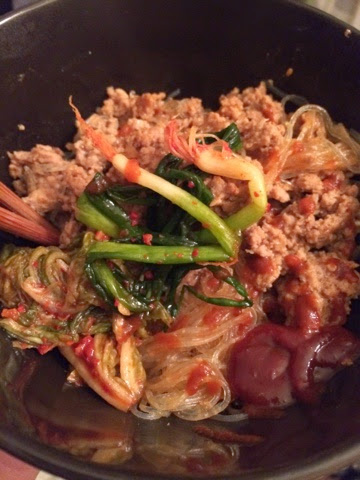
Ma yi shang shu, known in English as ants in a tree, is a Sichuan dish I recently discovered. The history of the dish was tough to find but the name comes from the way the bits of ground pork stick to the clumps of glass noodles as you eat it. I've modified the recipe very slightly according to my flavor preference and will note where that has happened. 

Soak a package of glass noodle in cold water for about 20 minutes. In the meantime, mix the following together:

1 lb ground pork
2 Tbsp gochujang (my modification!)
3 Tbsp soy sauce
1Tbsp flour or corn starch
1Tbsp rice wine vinegar

You can use your choice of spicy chili paste in lieu of gochujang, I just really like the sweet and tangy flavor. 

Marinate this mixture at room temperature for up to an hour. 

In olive oil, briefly sautée:
3-4 cloves minced garlic
1-2 tsp minced ginger

Add the pork mixture and sautée until nearly cooked through, stirring to break the grind into pieces. Add 1 cup of chicken stock and bring to a simmer. At this point I like to drain the glass noodles and lay them on top to steam finish. 

When the meat is done and noodles are clear, serve alongside scallions, pickled carrots/onions, kimchee, sesame seeds, Napa cabbage, etc. 

I recently made scallion kimchee using my regular recipe (with some Korean chili powder) and you can see the delicious result garnishing my dinner. 

Monday, October 6, 2014

Thai red curry pumpkin soup

Fall is soup season, hooray!! I adore soups any time of year but the cool weather gives me an excuse to cook it several times a week. The base of this soup is a simple Thai red curry and chicken soup but after making it several times I began matching other flavors to it. We have the most beautiful squash coming into season right now and I decided to go for it. There's not a big history for this dish since it's about as ubiquitous as chicken soup and because I'm modifying it, so let's get down to it. 

Roast approximately 2 cups of chopped, oiled squash (sweet pumpkin, butternut, buttercup, acorn, etc) at 350 until soft and lightly golden on the bottom. 

When finished add squash to a blender with 1-2 inches of peeled ginger, 3-4 cloves of garlic, 2-3 Tbsp Thai red curry paste, and enough oil to help it blend smooth. 

Sautée for 2 minutes on medium high then add 1 can of high quality coconut milk and about 3 cups (2 cans) chicken broth (make it as thick or thin as you like; the squash really thickens things up). Salt to taste. It's ready when hot!

Serve with rice or glass noodles, and your choice of condiments: chicken, tofu, mushrooms, scallions, chilies, and fresh herbs. I used whole sage leaves during the broth heating stage and it was wonderful. 


Saturday, August 23, 2014

Greece!

As a Greek, leaving Greek food off my food blog is apparently just as bad as being single after 30. This is one of my favorite easy meals to make. It is one I've been able to keep it on my menu through all the financial highs and lows and it nearly always draws compliments. 

Spanikopita! I realize that this dish is usually served as an appetizer or snack, but I find it a fun and fairly well rounded meal. I've heard that some Greek recipes call for a thicker dough, so the product looks more like a calzone than my dish. I've also recently learned that it is found in others areas by similar names. My Bosnian neighbor nearly jumped for joy when I served it to her. 

Melt (don't clarify) 1/2 -- 1 cube/stick of butter. You'll use this from start to finish during construction. 

Sautée 1/2 minced or whatever yellow onion in..... Butter. Salt lightly. 

I prefer to brown my onions heavily. Transfer finished onions to a large mixing bowl and allow them to cool a bit. While the onions cool, open 1 can of spinach (you can also use frozen spinach or fresh spinach. I'm using the recipe I came up with in grad school) and allow it to drain in a colander. Add spinach to mixing bowl along with 4-7 eggs, 1/4 tsp nutmeg, 1/2 tsp pepper, and approximately 1/2 lb feta cheese. Mix with your hands. 

Construction:
Liberally butter the bottom of a 9x11 pan. Place 7-10 sheets filo, then pour all the spinach mixture, top with 7-10 additional filo sheets. Butter the top of these sheets (don't be shy) and add another 3-5 sheets. You guessed it... Butter the top of that layer!

Use a sharp knife to cut it into squares or diamonds and bake for 50 minutes at 375. You can serve it hot, cold, or at room temperature. I love it got because you get the crispy texture of the butter "fried" filo on the top and bottom. 


Many recipes call for unsalted butter. I prefer to use less butter in the actual filling and treat the butter like it's a condiment. It's a pretty cool flavor feel in the mouth to have the buttery saltiness in layers. The feta available in the average American grocery store is pretty salty on it's own which can add a lot of seasoning on it's own. You don't actually have to salt anything if you follow my college recipe. 

Enjoy!

Wednesday, August 20, 2014

Spin on Tunisia!

Harissa is another wide spread food found primarily in Tunisia, Morocco, and Algeria, but I grew up with something similar with my Greek background. Traditionally made with hot red peppers, I've taken a spin off the recipe and come up with a fresh, herby condiment that can be used on just about anything. Our favorite way to use it is mixing it with Israeli (pearl) couscous, but our dinner guests put it on the fish and roast veggies as well. 

In a blender place:
1 bunch cilantro
1 bunch parsley
2-3 jalapeños
1/4 c lemon juice
1 tsp coriander (I used ground, but seeds would add a nice pop of flavor)
1-2 garlic cloves
1-2 tsp salt (careful! Lemons will cover part of the salt you "feel" in your mouth)
1/2-3/4 c olive oil

Blend it all to a homogenous but not smooth consistency. We store ours in the fridge but take it out to come to room temperature before use. It should really look like a chunky herb oil and you can drizzle additional olive oil into it before serving. Maybe I'll try the traditional recipe soon!


Saturday, August 16, 2014

Improv night!

My boyfriend seriously dislikes eating leftovers. This is something he didn't bother telling me until after I had force-fed him leftovers for the first few months we were dating. It's a fun challenge to come up with new and inventive ways of feeding him and tonight I feel like I really slipped on over on him. I repurposed some leftover fish. Genius!!

Seems like I always have a freezer full of fish and I hate wasting it. I used a firm white fish (halibut, cod, tilapia is fine) braised in half shoyu, half water with 4 slices of ginger. The rest was just frills!

Bring your diluted shoyu to a simmer and toss in whatever sounds great. I used some leftover ginger, kabocha squash chunks, and leftover enoki mushrooms (you can also steam these so they retain their white color). Simmer 8 minutes and add the fish. Braise for 3-4 minutes and flip. You're pretty much done after that. 

I served it over rice with a sriracha cream sauce (creme fresh with sriracha to your desired temperature), rice seasoning (furikake), and a scallion and carrot garnish. 

My boyfriend walked in the kitchen and said "that's going on your blog, babe." And proceeded to eat dinner in about 2 minutes. Success!


Friday, August 15, 2014

Japanese fare

How difficult is it to choose a dish from a culture that celebrates food as much as the Japanese! There are a number of "typical" Japanese dishes but I chose Udon for my first foray into their food culture. Udon is extremely simple-not many ingredients- and the flavor of the ingredients is subtle instead of explosive, but every ingredient is identifiable and stands alone. 

Udon actually refers to the thick, milled wheat noodle typically used in a hot soup - of which there are regional variations. I used the simplest recipe I could find and was still impressed with the complex flavors it brought. 

Instructions:
Bring 5 c water to a boil and add a 3x5 piece of dashi and 1/3 c bonito flake. (I have a tough time finding bonito flake at times in my town and have heard that you can use dried shiitake mushrooms as a substitute. They have a totally different flavor but kind of a similar flavor "level" in this soup.) After about 5 minutes, strain your broth to remove the flake and dashi. Add 2-3 Tbsp dark shoyu, 1 c chunked kabocha squash, and a nice bundle of enoki mushrooms. Simmer until squash is tender- about 10 minutes. 

In the meanwhile, prepare udon noodles according to the package instructions. Usually, bring water to a boil and add noodles. Boil 10-13 minutes and then strain and rinse under cold water. 

Place noodles in a bowl and arrange the hot ingredients. Top off with hot broth and garnish with thinly sliced scallions.